
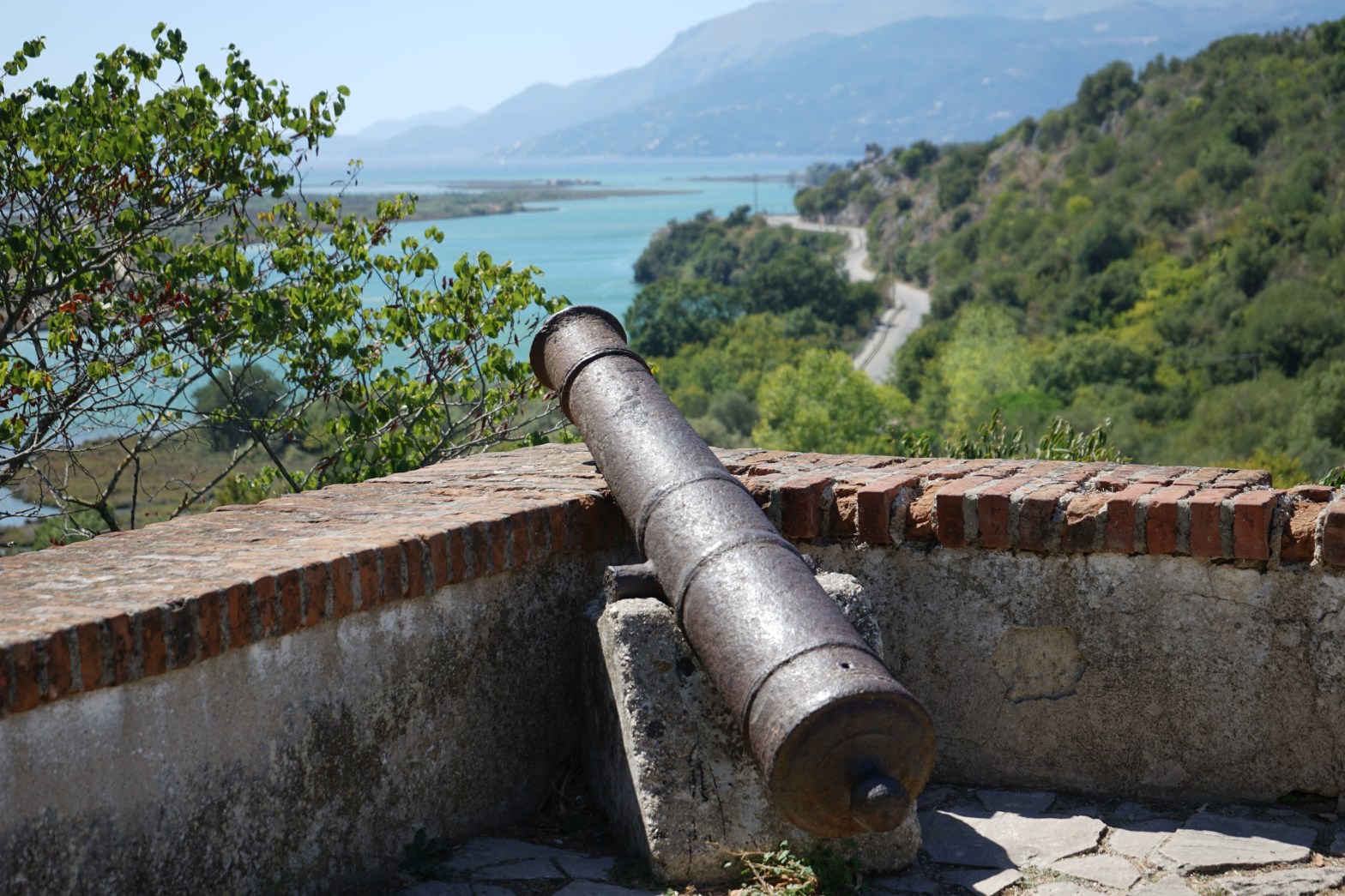
Visiting Albania is like walking over a fossil bed; there is so much history that one does not even realize is there hidden below each step. The region was lost in a remote corner of the Ottoman Empire for centuries, isolated because of its mountainous terrain and mostly off limits, a blank section on the map, to Europeans.
We are traveling in Albania with 10-pounds of history textbook for ND’s online tenth grade world history course. I scanned through more than 2300 pages and there is not a single mention of Albania or ancient Illyria. In some way, Albania is still a blank spot on the map. And despite this being our third trip to the country, we came here knowing very little of the history.
In August we drove through the town of Tepelenë. I pointed out the castle towering over the highway, but we didn’t bother to stop. Decaying castles are everywhere in this part of the world and the kids had already had their fill. Without the history, a castle is just another ruin.
Later, I would regret not stopping to visit these ruins as I would learn that this was the home of the great Ali Pasha, the late 18th and early 19th-century ruler of this blank spot on the map.
With Albania inaccessible to Europeans as it was contained within the Ottoman Empire and isolated from the Ottomans due to the mountain ranges, a young mountain bandit name Ali slowly gained notoriety and power through his brilliant and ruthless use of manipulation, deceit, bribery and violence. Playing the great powers against each other, he built an empire within an empire spanning the lawless mountain regions of Albania, Macedonia and Epirus in Greece.
With the French and British skirmishing over control of the Venetian ports of the Ionian Islands, Greek resistors to Ottoman rule causing trouble in the Balkans and general lawlessness and banditry, the Sultan was initially happy to have a ruthless strongman like Ali bring order to the region. And Ali Pasha did just that, crushing resistors and sending their heads to the Sultan in Constantinople.
For fifty years he built his wealth and power, playing the Ottomans, Russians, British and French. In the rugged, wild lands of Albania his palace stood out in its opulence with its marble fountains, gold and jewel decor, velvet dressed guards and harem of forty women. Besides the gilding, rotting heads on stakes decorated the castle walls and Ali was known to roast rebels alive on a spit.

Lord Byron, the British poet and adventurer, visited Ali Pasha at the now crumbling palace in Tepelenë in 1809, describing him as a remorseless tyrant, a Mahometan Napolean Bonaparte with a deceptively kind manner.
His hard side was on full display when he proudly razed the city of Moscopole. This city was the cultural and commercial capital of the Aromanians, a stateless ethnic group that became dispersed over the Balkans following Ali Pasha’s campaign against them.
Like Napolean, Ali Pasha overextended himself and ran out of friends. He began to step on powerful toes as he expanded his sphere of power over Ottoman lands and eventually the Sultan turned against him.
In his eighties, an ageing Ali abandoned all his possessions as he fled the Ottoman army. His army deserted him, leaving him on his own. Even his sons abandoned him in the hope they would receive a pardon.
Holed up in a monastery, his last stand was him alone against the Ottoman army. Afraid to face him, according to legend, they shot him from below through the floorboards. His head was sent to the Sultan where is was displayed on a stake at the palace gates of Constantinople.
Along with those of Enver Hoxha, the fortifications of Ali Pasha still decorate the Albanian countryside. One of these, originally a Venetian fortress adapted for use by Ali, is within hiking distance from Himara. Surrounded by water, the fortress overlooks the beautiful but lonely bay of Porto Palermo.
Eager to revisit it after reading the history of Ali Pasha, I suggested we hike there one Saturday. We settled on a hike to the sweet shop in town as ND simply had too much reading to do for his history class. He hefted up his heavy textbook and said, “Do I look like I have time for old castles?”

 ADVENTURE-SOMEWHERE.COM