
There’s no better way to enjoy a miserable day than a good book or two hundred.
Belgrade, across the river, disappeared almost completely under a shroud of fog that has not lifted in days. Because the kids work on American time, we go to sleep late and wake late. But in the low light of these gloomy days, 11:00 am still feels like 6:00 am.
By the time we manage to eat breakfast, it seems like the day is already nearing its end. We go for a walk along the riverside and I enjoy the quiet beauty of the fog which seems to isolate one’s immediate vision like a vignette. But soon ND is eager to go back to his computer. He has been behind in his school work for weeks despite working 12 hours a day. His online school schedule is lopsided with a light workload during the first quarter (August-October) and an extremely heavy workload during the second quarter (October-December). He doesn’t appreciate going on walks during his downtime. He says he needs to use this time to relax and the only way to do that is with video games.

I consider going out myself, but now it’s already 3:00 pm and the sun is going down. So instead, I turn on my Kindle and read.
If any one item has changed the way I travel, it is the electronic reader. It seems like centuries ago that I would be desperately searching for a shop with English language books before a long bus ride. Or when I would trade with other travelers for almost anything. Or when the writing was so bad I felt like vomiting but continued reading anyway because it was all I had.
My precious Kindle Paperwhite can find me any book I want, anywhere that I may be. It’s almost full with about 800 books, yet it weighs almost nothing. And if I read one bad sentence, I can delete at will and go on to something better. This is what the information revolution should be about rather than Facebook, Youtube and other nonsense fountains.
We are currently staying in Serbia and I have a full library on the country in English at my fingertips in my Kindle. Our apartment here is shelved with old fashioned hardcover books in Cyrillic. They have been collecting dust since we arrived, but I wonder if I would have been tempted to open them up and take a look if I didn’t have a Kindle.
Instead, I downloaded a book about the history of Cyrillic.

The script was originally invented in the 9th century as an adaptation of the Greek alphabet by the Byzantine missionary St. Cyril. It also adapted some letters from the Hebrew script. It was created specifically for Slavic languages.
Cyrillic is also linked to the Orthodox religion. Seeing the new script as a threat to Roman Catholic influence, the Pope quickly banned Cyrillic in the ninth century. The Catholic Slavs, including the Poles, Czechs and Slovaks did not adopt it because of their Catholicism.
Within the former Yugoslavia, a single language was written with two different alphabets as the Catholic Croats used Latin and the Orthodox Serbs used Cyrillic. Rather than being divided by ethnicity and language, it was religion and alphabets. During the second world war, the fascist Croat regime banned Cyrillic and burned books written in the script.
Today Cyrillic is used in Serbia as well as Russia, Bulgaria, Macedonia, Ukraine and a number of other countries. Some, like Montenegro, officially use both the Cyrillic and Latin scripts.
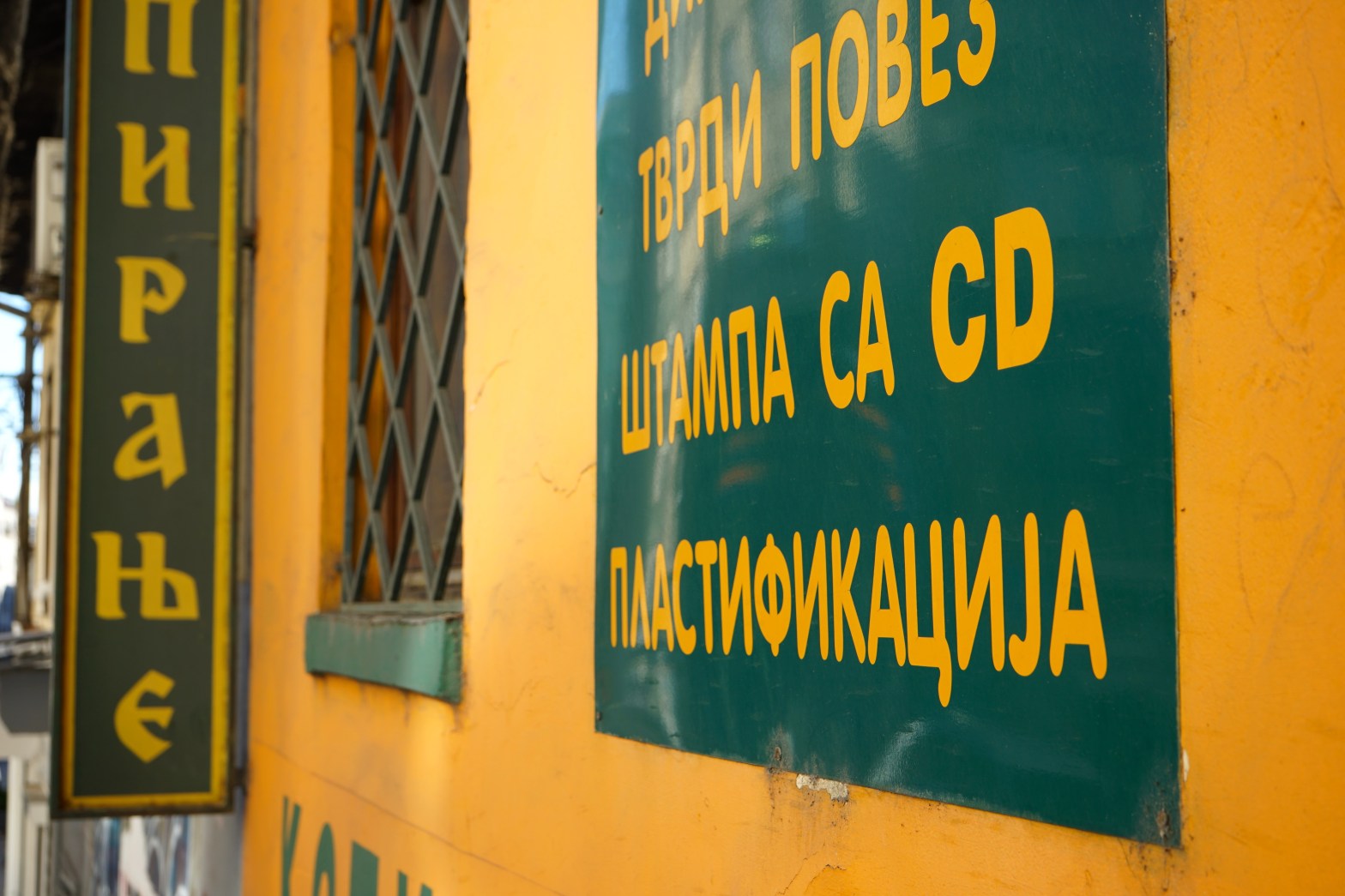
It is also surprisingly easy to learn, although the more familiar Latin characters in the alphabet are the most difficult, i.e. P is R, H is N, Y is U, etc. It’s also strangely satisfying to decode graffiti and street signs around Belgrade to find unexciting statements like “no parking” and “Serbia!”
So as much as I hope for a sunny day tomorrow, if it’s another dark, foggy one I can always stay in and read a book. Maybe I’ll pick up one of the dusty Cyrillic hardcovers and see what’s inside.
Србија!

 ADVENTURE-SOMEWHERE.COM