

The rock tombs have survived for thousands of years in the mountains of Lycia. Everything else has been lost to time so that very little is understood about the people that once inhabited this land. Once known as the Land of Light, the civilization that existed here thousands of years ago was quite a bit different from its neighbors.
From the age of the pharaohs through the empire building of the Greeks and Persians, the Lycians fought to stay independent and maintain their way of life. They had their own religion, language and writing system and their society was a matriarchal one in which lineage was traced through women rather than men. While empires grew and fell around them, the Lycians tried for the most part to stay out of the wars. In order to maintain peace, Lycia formed the world’s first known democratic union, the Lycian League. This provided inspiration to the Greeks and the Lycians were much admired for their effective system of governance.
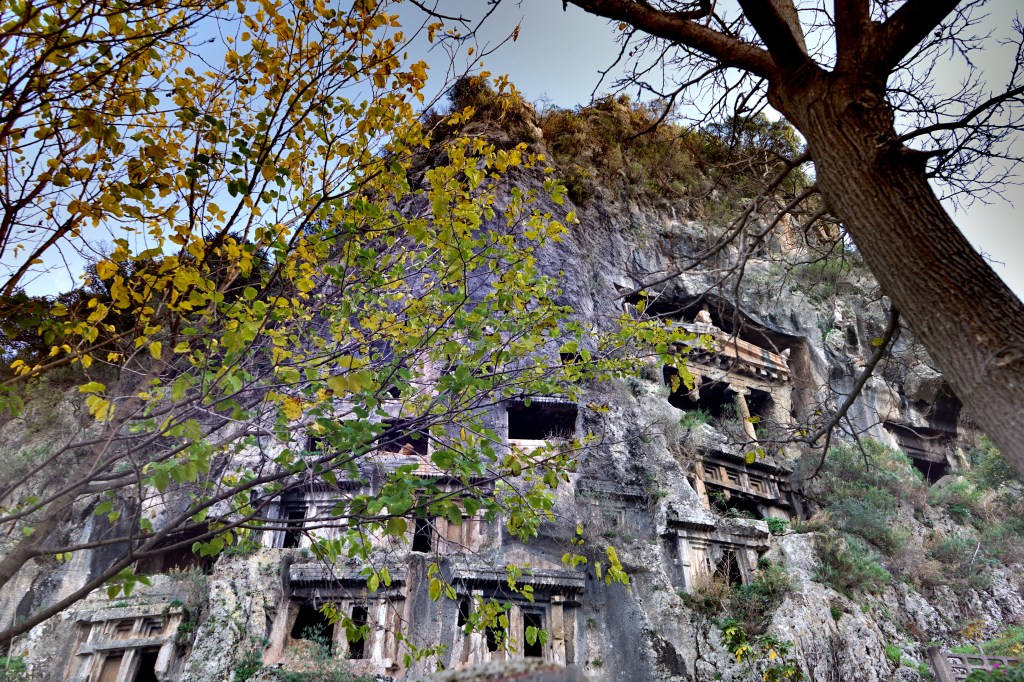
Central to Lycian culture was its ancestor cult in which tombs were built to house the dead. Intricately carved, many of these were carved directly into large rocks and mountain sides. These ancient tombs are so plentiful that they can be found almost everywhere today, from remote mountain trails, to the center of city roundabouts and even submerged in the sea.

A 540-kilometer trail passes through the mountains and along the coastline between Fethiye and Antalya and is known as the Lycian Way. This passes along remote mountains, isolated beaches and through the ruins of the ancient Lycian cities. Some dedicated hikers spend a month or more hiking the entire length of the trail.
Our trip from Antalya to Fethiye took us mostly along the highway that runs through Lycia, but we have searched out small sections of the trail to hike everywhere we’ve been in this region. The trail can be rough in some spots and it seems to disappear completely in others. It can pass through farms, villages and towns as well as meander far from civilization into the forests and mountains. And the trail travels through time, sometimes going back thousands of years, sometimes just a century or so.
Having lost Tola while walking in Fethiye, I found myself hiking alone earlier today along a short stretch of trail through some villages. Descending the steep mountain path I noticed an elderly lady slowly making her way up the path. Her back was bent parallel to the ground and she walked slowly up the dirt path with a cane held in each hand. With some difficulty she sat down on a rock. As I wondered if I should offer help, she noticed me and called out in Turkish. I said hello and she continued in Turkish, reaching to pick up a rock nearby.
I stood by as she made me understand that she wanted me to take the rock and throw it at some nearby goats. I did it and then she scrambled for another one. A bit mystified, I threw one rock after another at the goats while she yelled at them. Finally, the goats all moved away and I realized that she was trying to keep her goats from nibbling certain plants.
“Ingiliz?” She asked me.
“Yes,” I answered. “English. American.”
“Thank you,” she said in English and then repeated it again and again as she continued after the goats.

The Lycians appear in Homer’s Iliad fighting to defend Troy from the Greeks. Over the next centuries Lycia was caught between Greek and Persian influences and slowly came to adopt the Greek language and gods. The Persians invaded in the year 540 BCE. The citizens of Xanthos, the greatest city of Lycia opted to commit mass suicide rather than be occupied. For many years after this, Lycia changed hands between the Greeks and Persians.
Roman rule, and later Byzantine rule, brought more changes to Lycian cultures so that Lycia became just another province in an empire. The original language, religion and culture faded away and the art and traditions were replaced. The Lycians disappeared into history.

On the island of Kekova the remains of an ancient city are visible under the clear turquoise waters. We took a boat out to the islands and swam among some of the ruins. The city was sunken by a series of earthquakes nearly two thousand years ago. After its destruction the island became a haven for pirates and a castle was built opposite over the remains of a Lycian foundation. Here, as in all of Lycia, the civilization faded out and was slowly replaced over the centuries until nothing remained but the tombs dotting the hillsides.

 ADVENTURE-SOMEWHERE.COM