
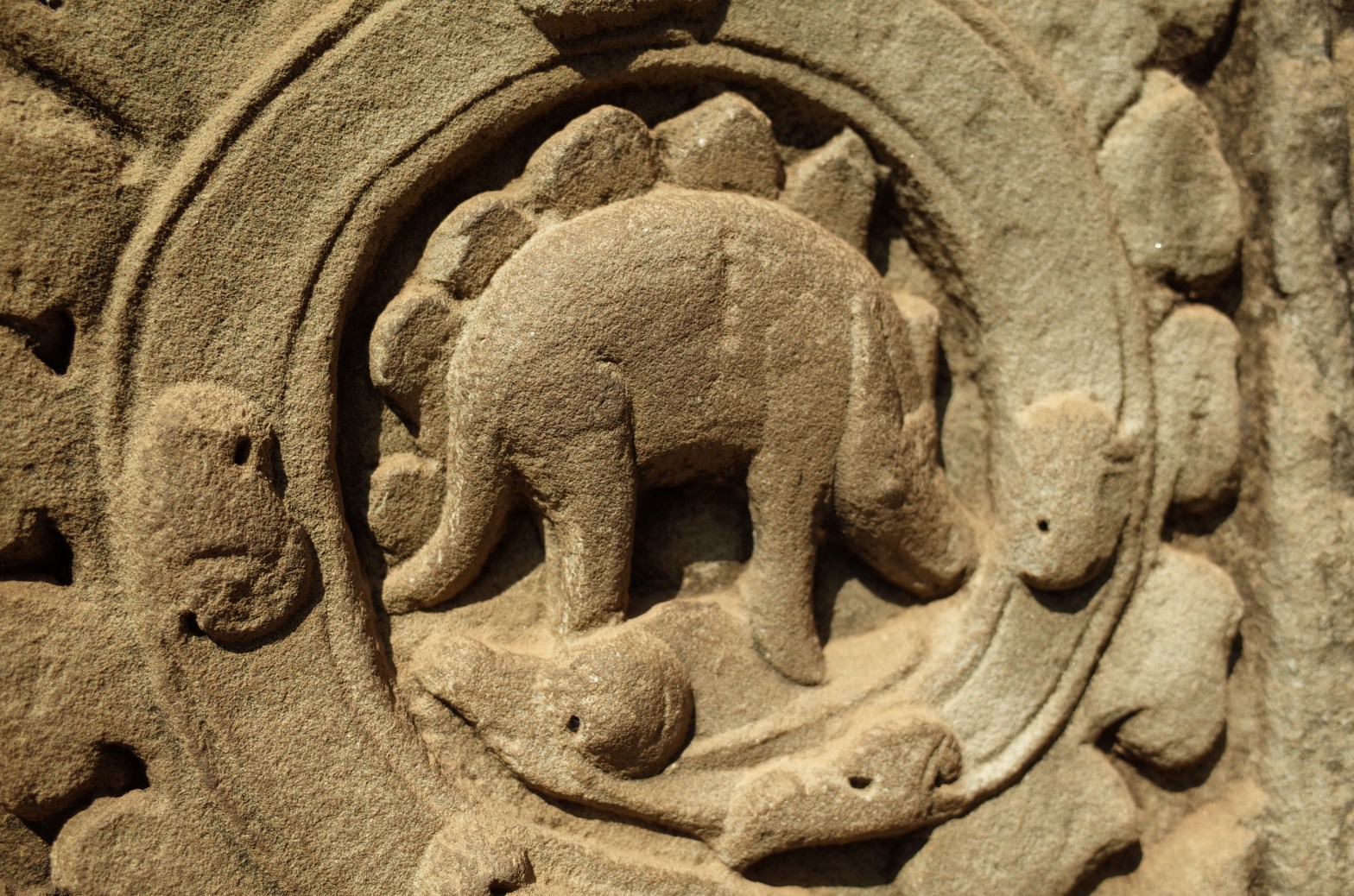
Hidden among Cambodia’s ancient temples is an 800-year old carving of what is assumed to be a stegosaurus, a dinosaur that went extinct 150 million years ago. Rather, the carving depicts an even more obscure creature, the elusive pangolin, a scale covered ant eater that can be found in the jungles of Cambodia. This creature has gained a bit of notoriety as of late in its connection to the current devastating pandemic that has spread around the globe. Evidence indicates that the virus may have originated in bats and spread to humans through pangolins.
The stegosaurus on the crumbling temple wall may be responsible for Covid-19. And if there was a Covid-01, it might have been responsible for that too.

Some countries have managed the current pandemic better than others, but is this the only reason for the vast discrepancies in rates of infection and fatalities? While more than half a million people have died due to Covid-19 in my home country of the United States, a grand total of zero have died in my home away from home of Cambodia.
How has Cambodia managed this?
Early in the pandemic while cruise ships were being turned away from port after port, Cambodia welcomed the passengers of the MS Westerdam into the country, many of which it later turned out were infected with the virus. Since then there were many other instances of infected people arriving in the country, but Cambodia never had more than a few cases and no one died of the virus.
There has been some speculation that the heat and humidity of Cambodia limits the spread of the virus. However, the climate in Cambodia is fairly similar to Brazil where hundreds of thousands have died so it seems unlikely that this has too much to do with it.
It has also been mentioned that people in Cambodia generally greet by pressing their hands together rather than shaking hands. While there may be some truth to this in that this greeting is more hygienic than hand shakes, it can also be noted that other countries such as India also greet like this but have suffered large numbers of fatalities from the virus. A number of issues with hygiene in Cambodia make this a moot point anyway. People generally live close together and handwashing is not especially common.
Cambodia has lived through periods of infectious diseases before. I’ve been there during outbreaks of swine flu, avian flu and SARS. The people in Cambodia are no strangers to face masks. However, I don’t believe people are so careful as to avoid the pandemic completely. Cambodia has either been extremely lucky or the country is inundated with antibodies.
Covid-19, or Corona Virus Disease 2019, was so named because it was identified in 2019. The virus that causes the disease, SARS-CoV-2, or Sudden Acute Respiratory Syndrome Coronavirus-2, is so named because of its genetic similarities to the SARS Coronavirus, a deadlier but less contagious version of the virus that broke out in 2002. This virus has been around for a long time in some form that may be different, but similar to the current virus that is wreaking havoc around the world.
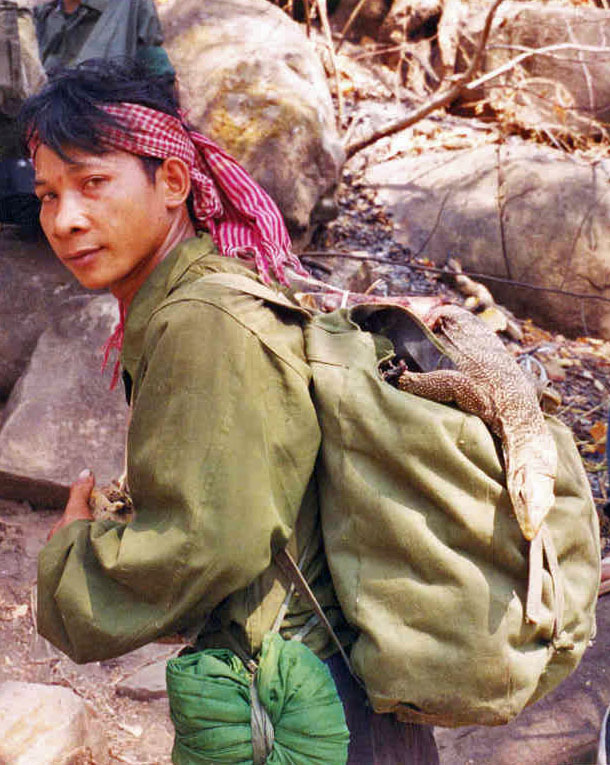
I first traveled to Cambodia at the age of nineteen and I spent quite a bit of time in the remote jungles where the few people I met were tribal villagers that would spent days in the forests catching rare creatures which they would then carry for days out of the forest to sell to Chinese contacts who would then send the valuable parts to China for use in Chinese medicines. In those days, specialty restaurants in Phnom Penh would also display cages of live forest animals, including bats, that one could order to be made into a soup.
The Cambodia of twenty years ago was a remote, undeveloped backwater in which there were few rules and everything seemed to be falling apart. The National Museum was home to a massive bat colony that dropped guano onto the artifacts below. The cavernous interiors of the temples of Angkor also reeked of the pungent ammonia smell of bats.
One of my first jobs in Cambodia took me to the temple of Preah Vihear which could only be reached at that time by foot. There were so few visitors to the temple that my entrance surprised a colony of nesting bats that swarmed me like something out of a horror movie.

The year 2001 was one of the most exciting years of my life, but it was also one of the worst. I got sick with a fever and lung infection that left me out of breath and with severe arrhythmia. For months afterwards I felt as if I were in a fog. It was difficult to think clearly and my heart seemed to think I was trying to run a marathon. Doctors in Cambodia and Thailand, and eventually the US, couldn’t give me a diagnosis. I’ve been seriously sick a few times with things such as food poisoning and malaria, and while unpleasant, they were nothing compared to my mystery illness. I suffered for almost a year with heart issues, anxiety and headaches until the symptoms began to fade away, although I did get something similar but much more mild in Cambodia once again many years later.
I never found out what it was that destroyed 2001 for me, but in considering the limited way in which the pandemic has affected Cambodia I have begun to wonder if it was related to some form of a coronavirus.
Recent analysis of bats from Cambodia that were frozen for study ten years ago show that they were infected with a coronavirus that is almost identical to the one that causes Covid-19. These bats were captured a decade before the current pandemic in Cambodia’s Preah Vihear region. This seems to indicate that the virus may have originated in Cambodia. Could it be that the reason nobody has died of Covid-19 in Cambodia is that the country already has herd immunity from decades or longer of exposure to a similar virus? Cambodia is surrounded by three countries, Thailand, Laos and Vietnam and these all have very low rates of infection and fatality. Cambodia appears to be ground zero of Covid-19 immunity.
The worst illness of my life remains a mystery, but maybe it’s not such a stretch to speculate that it may have been a coronavirus infection, Covid-01 for the year 2001. Maybe it was something else, but either way, I plan to stay clear of bats and pangolins.
And stegosaurus as well. You never know.
Some links to new research on SARS-CoV-2:
https://www.biorxiv.org/content/10.1101/2021.01.26.428212v1
https://www.eurekalert.org/pub_releases/2021-02/tfci-pcc020521.php
 ADVENTURE-SOMEWHERE.COM