

Ancient Olympia: site of the first Olympic games 2797 years ago and a brief stop on our road trip across the Peloponnese.
We arrived in the evening after a long day of road and ferry and left the next morning, satisfied that we had seen something amazing even if I had spent most of my time in town trying to park our car.
We noticed blackened hills surrounding the Olympic valley: some of the destruction of the many wildfires that raged through Greece over the summer. The town of Ancient Olympia was evacuated only a month or so before we arrived and the ancient ruins came under serious threat from the fires. It wouldn’t have been the first time that these temples were threatened.

For over a thousand years the Olympics were held at this lost city every four years without fail in honor of Zeus, the king of the gods. The Greek world, full of warring city states, would call a truce for 3 months for the Olympics to be held so that athletes from all over could travel to Olympia and compete in the games.
With little time to visit the site, I woke the morning after our arrival at 6:00 am to get an early start before our 11:00 am check out time and another long drive ahead. I shook NG and ND, but they wouldn’t get up. After a busy week of travel and activities, they were more interested in sleep than seeing another pile of broken stones.

Long abandoned, the Olympic ruins were only found in the 19th century after a thousand years ruined and buried under a layer of mud and silt. Besides the sport buildings such as the stadium and gymnasiums, the ancient city was home to numerous temples and holy sites such as a temple to Gaia, the earth goddess, and Hera, queen of the gods.
In the middle of it all, though, was the building to which the city was dedicated, the Temple of Zeus. This massive building housed the famed statue of Zeus, one of the seven wonders of the ancient world. Built by the master sculptor, Phidias, the 12.5 meter high statue was made of gold and ivory.
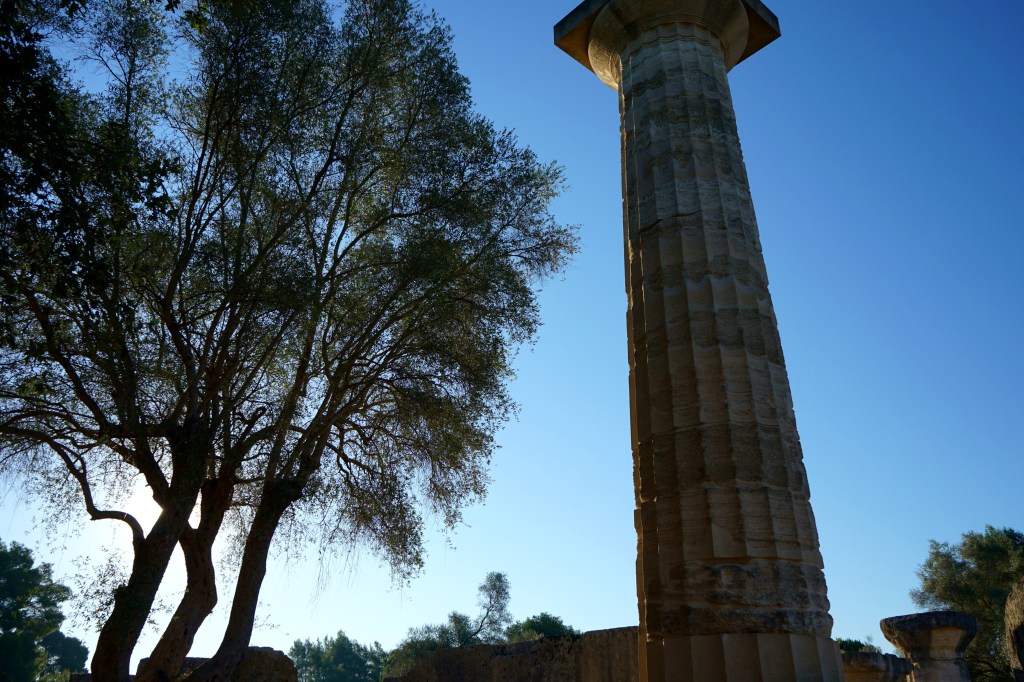
All that remains of the temple are broken columns, a single one re-erected to demonstrate the awesome size.
Most of the buildings of Olympia are in ruins, scattered pieces of once great structures. Sign boards displayed on each building tell of the earthquakes that felled them, but the truth not mentioned on the tourist sign boards is that these buildings fell to the hand of man long before the mentioned earthquakes.
The Christian Emperor of Rome banned the Olympics in the year 393 and waged a war against the old religions. The sanctuaries to the old gods were raided and toppled. The statue of Zeus was dismantled and locked away before it was lost forever to fire. The workshop of the master sculptor Phidias was converted into a Christian basilica.
Nearly three hundred Olympic games were held here over a period of more than a thousand years without missing a single one until the day they were banned and the Olympics were lost.
Fifteen hundred years later, though, not long after the excavation of Ancient Olympia, the games were revived in Greece with the first modern Olympic Games of 1896. To this day, the Olympic flame is lit every four years in Ancient Olympia.
Walking through the quiet ruins of Olympia, it takes some imagination to see the glory that once existed here, but the connection this ancient place still holds to the present is pretty amazing. The kids don’t know what they missed, but maybe one day when they are watching the Olympics on TV they’ll think of the time they slept in at the place that started it all.
 ADVENTURE-SOMEWHERE.COM