

At one point in time the leaders of two countries sat down and signed a legal document, shook hands and then got started on some fully legal ethnic cleansing. To be exact, the plan worked out to be a religious cleansing more than ethnic. Millions of people would be forced out of their homes and ancestral lands because of their religion. This is why today only snakes roam the walkways of what once was a thriving town in the hills above the Mediterranean in the ancient land of the Lycians.
It would take more than a few hours to fully explore what is left of Levissi. The kids arrived with a bit of skepticism. After visiting countless ancient ruins and amphitheaters, they had begun to experience the strange condition of history fatigue. I don’t understand it myself, but apparently some people get tired of exploring ancient ruins and would prefer to spend their free time playing video games.
“This one is different,” I tried to convince them as I concentrated on the turns of the narrow road that winds through the thick pine forests towards Levissi. “This was a living town only a hundred years ago.”
“How does that make it more interesting?” ND asked.
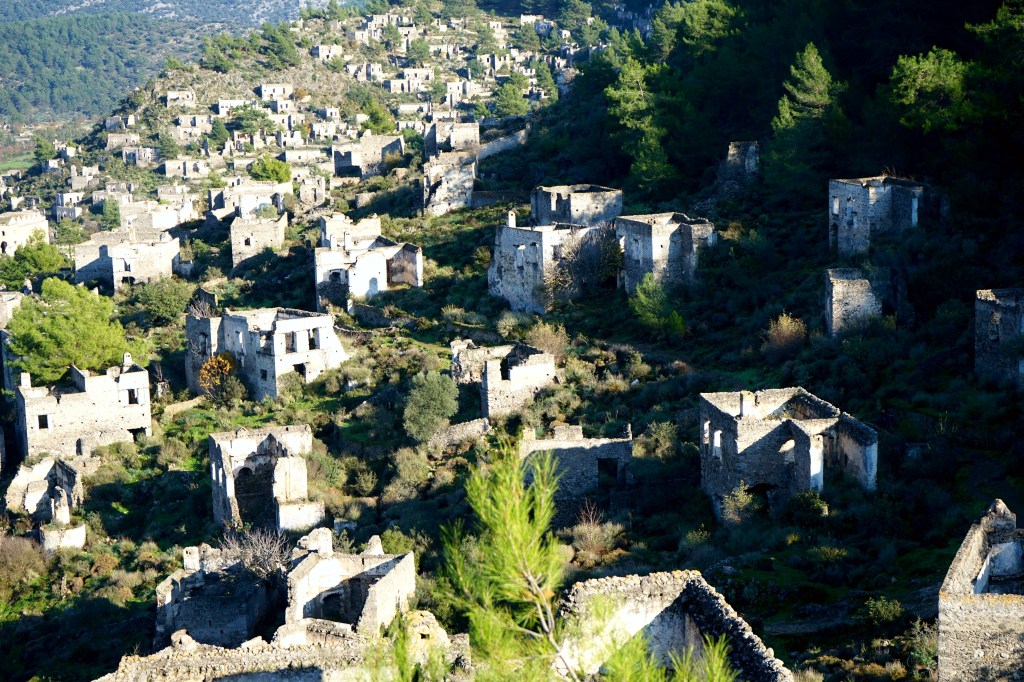
Although only abandoned for a hundred years, the ruins have the same sense of being reclaimed by nature as the lost jungle temples of Cambodia. A fifty-meter pine tree grows out of the center of the living room of one house. Others have oaks growing out of their roofs and even more are crumbling under a tangle of vines.
This is a historical region built over the tombs of the ancient Lycians. It was a crossroads of ideas influenced by the Greeks, Persians and Romans. The Greek language and Eastern Orthodox religion became firmly entrenched here during the age of the Byzantine Empire and then the region became quite multi-cultural under the Ottomans with people speaking a variety of languages and practicing both Islam and Christianity side by side.
Levissi might still be a living town where Christians and Muslims peacefully coexist had it not been for a war that never even touched the town. Following the first world war, Greece invaded the Ottoman Empire hoping to take advantage of its weakened state to take back the lands that were once Greek. This became a religious war in which the Greek armies tried to cleanse the region of Muslims, murdering civilians and burning mosques and the Turkish armies retaliated by targeting Christians and churches. The large multi-cultural city of Smyrna was effectively razed to the ground this way.
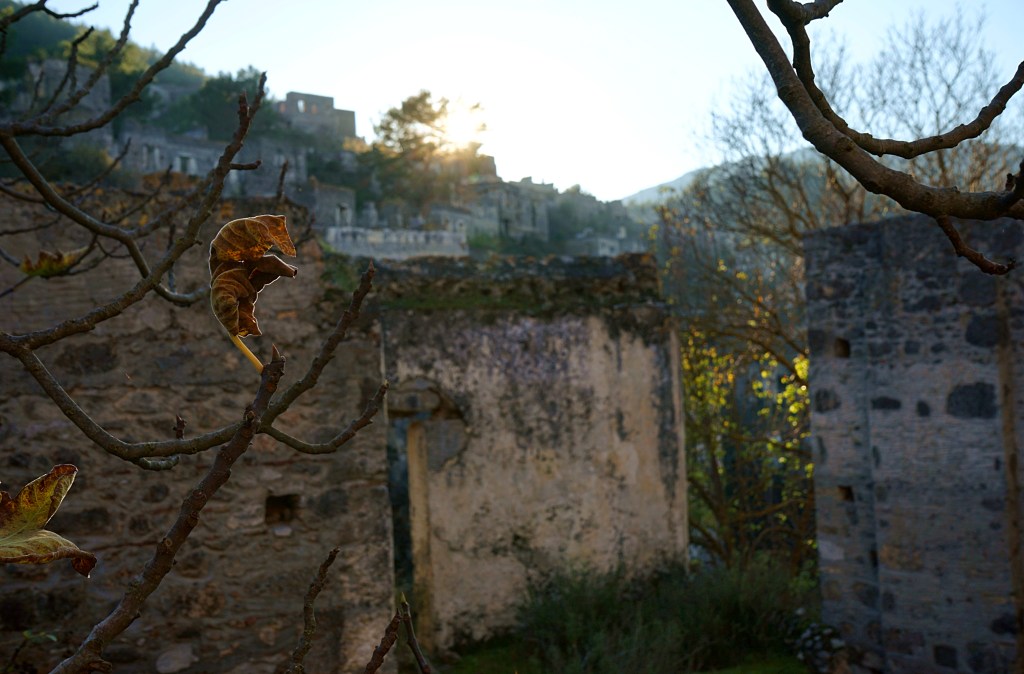
Although Levissi was largely spared the destruction of war, it became a casualty of the armistice. In 1922 Turkey and Greece decided on a population exchange in which Greeks within the borders of Turkey would be sent to Greece and Turks in Greece would be sent to Turkey. While this might have sounded like a good idea on paper, the reality of it was a brutal uprooting of people from their homes and it had nothing to do with nationality or even ethnicity. It was all about religion. Muslims Greeks were deported to Turkey and, in much greater number because of the history of Christianity in Turkey, Turkish speaking Christians were deported by the millions to a country where they knew no one and could not speak the language.
An old stone and dirt path winds its way steeply through the abandoned town. We wander off of it to climb stairs that once led to an upper floor but now lead to a big drop. A second floor fireplace hangs in the air by its chimney; the floor must have collapsed long ago. An abandoned chapel glows from tits windows, the soft light of late afternoon brightening its interior through the open doorway and I notice a snake slither into the doorway as we walk by.
We find the path again and I continue walking up as Tola and the kids explore an empty well. As quiet as Turkey feels amid the pandemic and its weekend lockdown, this town feels spectacularly abandoned. This is not a ghost town because even the ghosts have gone.

But we aren’t the only ones here. An older couple, each of them gripping walking sticks, is ahead of me on the path to the hilltop shrine above the town. I pass them and say hello as they stop to sit and rest on a crumbling veranda overlooking the ruins below. As I turn back to the path, my foot stops short of a snake lying head to tail directly over the walkway.
This isn’t just any snake though, it’s a venomous Ottoman Viper. I hate to bother snakes, but with the old couple ready to go again soon and my kids a few minutes behind I can’t let it stay here. I move back and softly toss a pebble at it. The viper springs to life and comes after me. I’ve never seen such an aggressive snake before. I have to jump back multiple times as it tries to strike. Eventually it moves into some bushes off the trail and it’s safe for us all to walk by again.
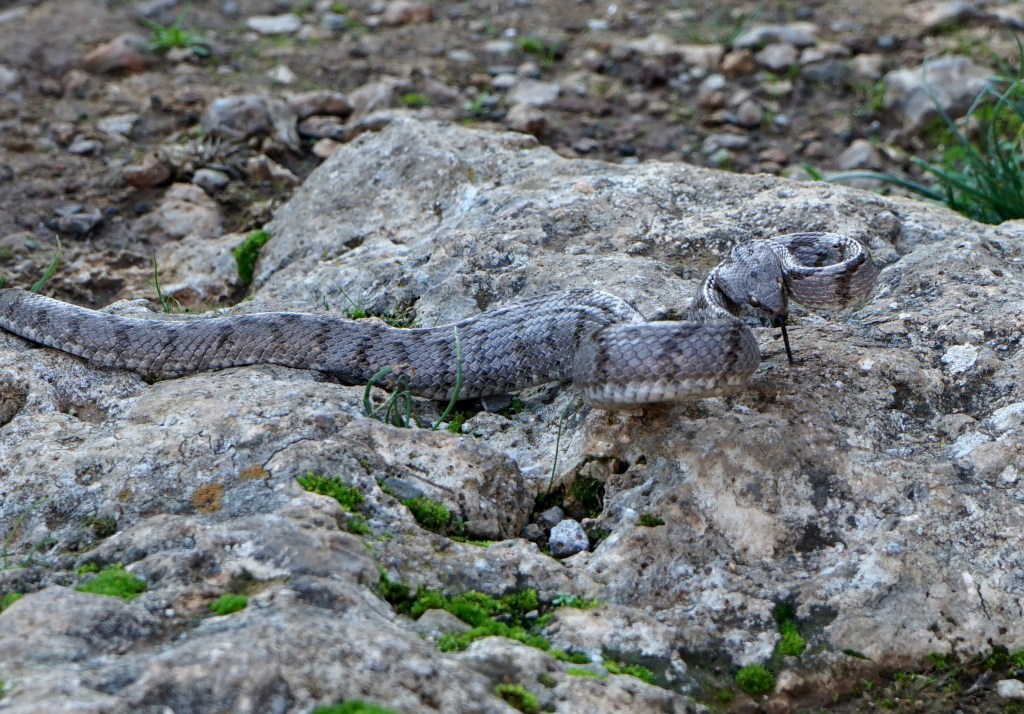
We will walk through, but the crumbling buildings, the empty churches and the overgrown pathways of this town belong to nature now.

 ADVENTURE-SOMEWHERE.COM