

Only two of the original seven wonders of the ancient world still remain in any form. In all my travels I have not yet seen a single one of these until now. And this one, the Great Temple of Artemis, has barely survived the ravages of time itself.
Ephesus, founded by the Amazon queen Ephesia according to legend, grew to become one of the most important cities of the Greek world. Before the Greeks, the people here worshipped Cybele, a Mother Earth goddess of fertility and this morphed into a cult devoted to the Greek goddess Artemis.
Artemis was the Greek goddess of nature and hunting as well as a protector of women, but she adopted more eastern characteristics in Ephesus. The Ephesus Artemis is heavily adorned crown to toe in symbols of nature and fertility, including bees, flowers, seeds, livestock and a drapery of bull’s testicles.
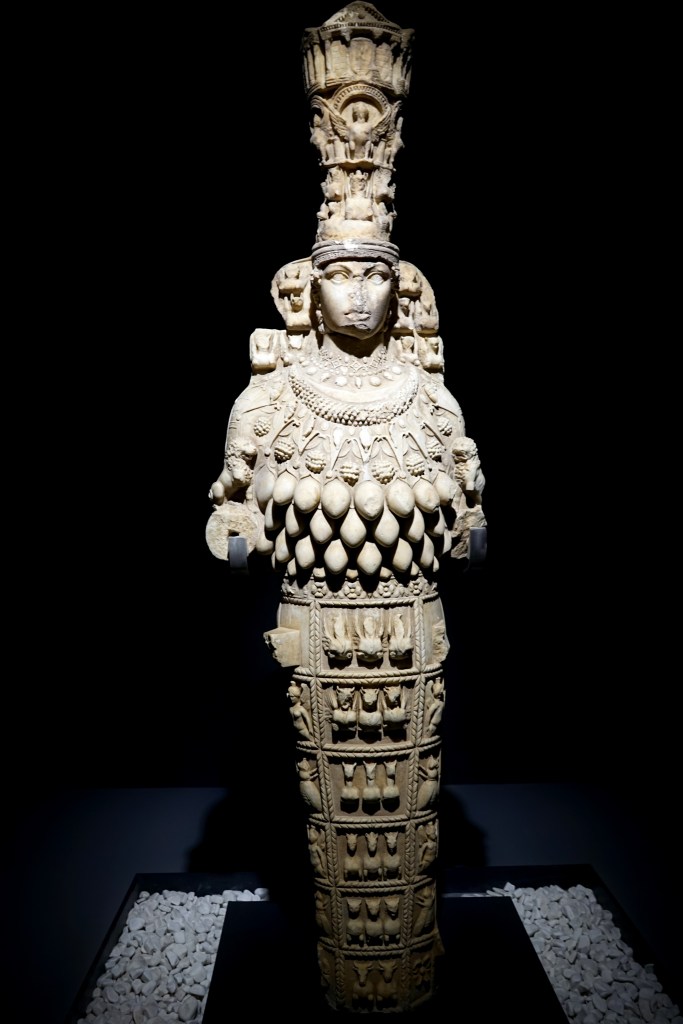
The Temple of Artemis was built more than 2500 years ago and, at twice the size of the Parthenon in Athens, was the largest temple in the world. Ephesus was home to a devoted cult of followers and the region was a crossroads of ideas between the East and the West where visitors from near and far would pay their respects to the goddess.
This changed in the fourth century when the Roman Emperor Constantine adopted Christianity. Pagan beliefs were soon banned and the temple was torn down, a wonder of the world left to ruins in the dirt.
The Byzantines built a massive church, the Basilica of St. John, on a hill overlooking the ruins of the Temple of Artemis. Not much remains of this building either, although it seems that this is the site that tourists come to see as it is gated with a ticket booth and turnstile entry while the Temple down below remains neglected and overgrown with weeds.
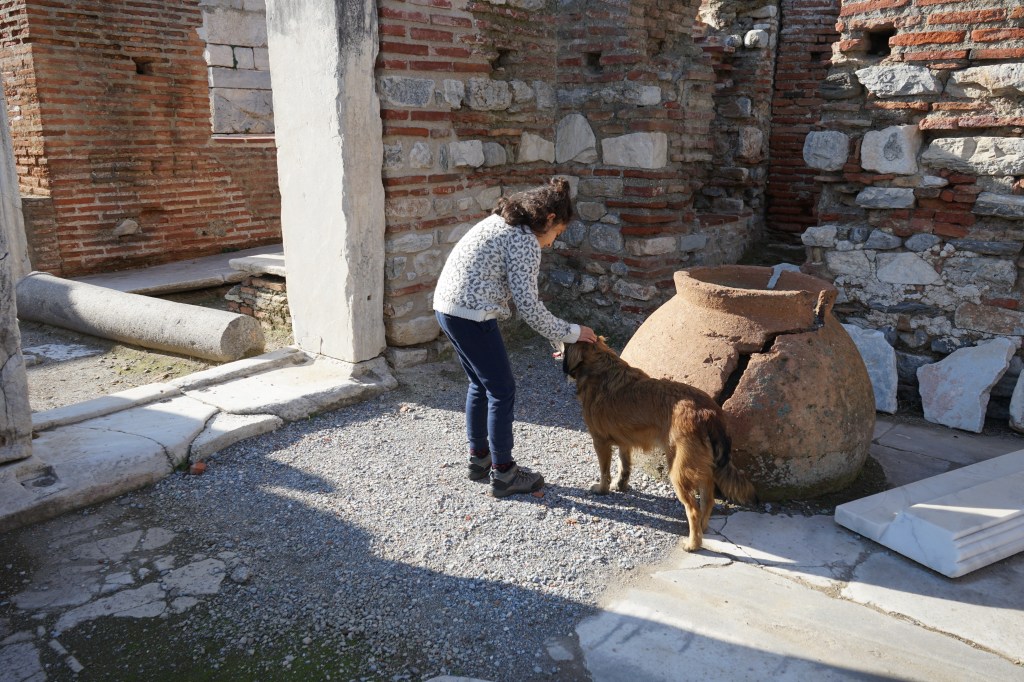
On our way up the hill to the basilica, we met a friendly dog who, after receiving a pet from NG, decided he would lead the way. When we turned up the wrong street, the dog galloped ahead on the correct path and waited patiently for us to follow. Finally, he led us straight through the gate and slipped under a turnstile ahead of us. The guards yelled and shooed him until he exited, but he entered again with us as we scanned our tickets. I looked at the guards to see what they would do, but they all seemed to be looking away so as not to have to deal with our unticketed canine guide.
St. John was one of the disciples of Jesus and is credited with writing the fourth gospel and Book of Revelations. According to belief, he brought Mary, mother of Jesus, to Ephesus where he later died as was buried on the hill over which the basilica was later built. This region was the heartland of early Christianity and the early adoption of the religion here paved the way for its spread into Europe.
Our dog friend continued to guide us from one annex to the next within the remains of the basilica. I noticed that he was doing quite a bit of intense sniffing at numerous locations and I started to keep an eye on him, wondering as to which piece of ancient wall or artifact he would choose as his target. But he kept it classy, while in my presence anyway, and never tried to lift his leg.
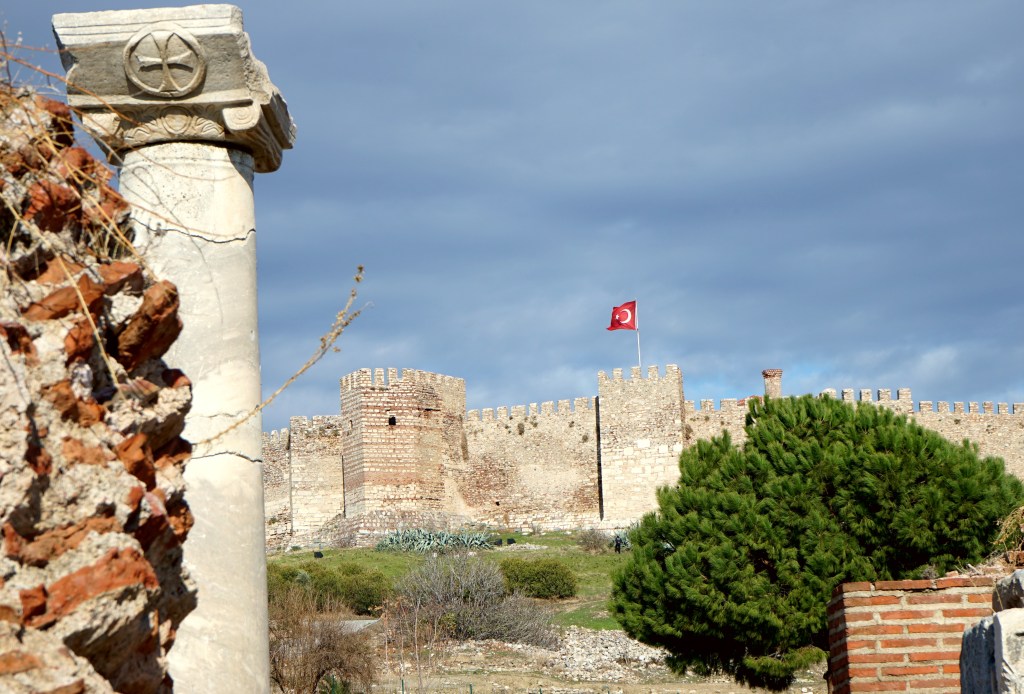
He guided us all the way up to the Byzantine and Ottoman era castle overlooking the town farther up the hill and then back down to exit the turnstiles where the guards once again looked away so as not to notice him.
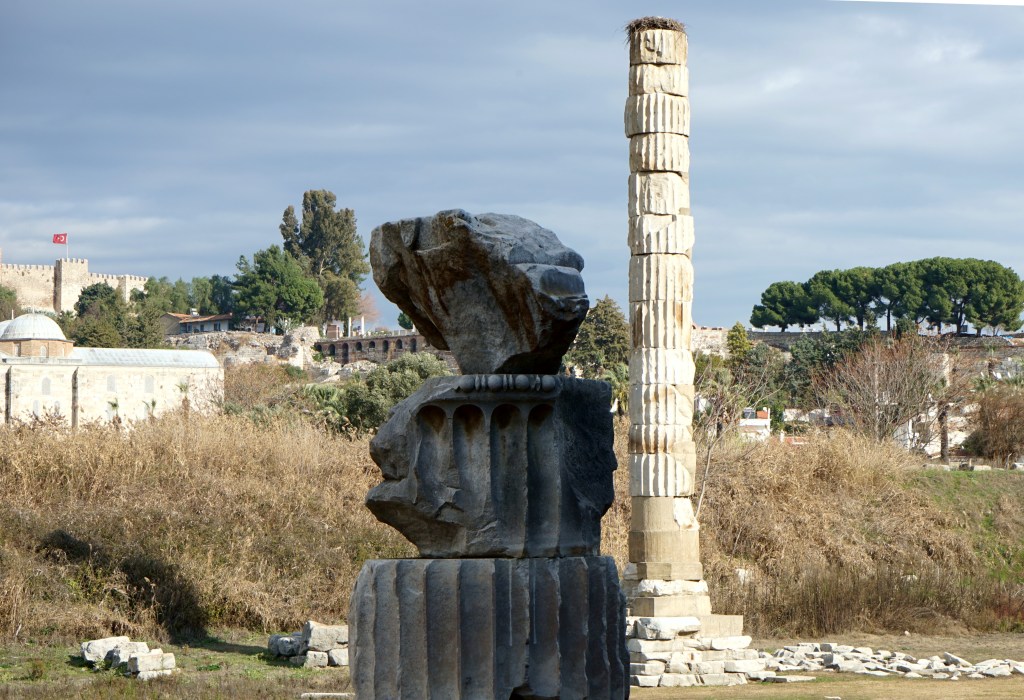
The way down leads past another Byzantine-era church that was later converted into a mosque. A short path from there through some forest leads past an old tomb and to the remains of the Temple of Artemis. Nineteenth-century archeologists spent years searching for this legendary temple before finally discovering its sparse remains, buried and in pieces. One column was re-erected and it stands, not as high as the original, but still imposing, a sad reminder of the life and death of the great temple that once awed visitors from distant lands.
According to Christian myth, St. John once entered the Temple of Artemis where believers gathered to offer their respects to the statue of the goddess and challenged them to pray to her to strike him dead. They refused and St. John then cursed the goddess in front of everybody after which the statue burst into pieces, killing the high priestess and the temple collapsed. All the followers of Artemis converted to Christianity on the spot.
It felt as if the temple had not been visited in a long time and while there is little to see, the site seems to hold an alluring sense of power like that of the grave of somebody once important. Our guide slowly wandered over to the lonely column, sniffing the weeds intensely along the way, and finally lifted his leg. It seems the temple still does have one true believer.


I knew it sounded familiar – I’ve been there! I went on a trip called In the Wake of Ulysses – that was one of our stops – I will try to find pictures – so long ago bug such an incredible trip – love your writing – feel comfortable putting the kids and Tola in them? their reactions would be real interesting to me ie (“Dad, you say someone is buried here?” “what did they eat?” “were there dogs and cats as pets? (from Angie); etc etc – my examples bad but thenits only January 1- n
On Fri, Jan 1, 2021 at 6:03 AM ADVENTURE-SOMEWHERE.COM wrote:
> Luke Somewhere posted: ” Only two of the original seven wonders of the > ancient world still remain in any form. In all my travels I have not yet > seen a single one of these until now. And this one, the Great Temple of > Artemis, has barely survived the ravages of time itself. Eph” >
LikeLike
Been there. Done that. Pet the dog. LOL
LikeLike
stop
LikeLike