

There is nowhere in the world like Ithaca, an island lost in time and myth in the Ionian sea. Home to a population of only 3000, the island has been a long lost home to the countless souls who have traveled the wine dark seas with Odysseus over the past 3000 years in the many recitals and readings of his epic adventure.
We departed the island of Lefkada by ferry on a quiet, sunny afternoon on my birthday that turned into a rough and windy evening as we approached Ithaca. The rolling waves rattled the ferry like an earthquake and drowned our car in salty sea spray.
The Ithacan landscapes are rugged, much like the seas around it. Our ferry landed at a little port village of 80 people on a small bay surrounded by mountains. Most of the roads on the island are so narrow that we must pull over when another car comes from the opposite direction. But there are not many other cars here. Unlike many of the other Greek islands, Ithaca attracts few tourists.

This is an island of goats. They wander the craggy hills, the forested mountains and the abandoned stone wind mills along the coast. They leave their droppings over the almost indistinguishable ancient ruins that hide beneath the brightly colored vegetation that grows over the island.
There are no cities on Ithaca, only villages and small ports. Many of the mountain villages are partially abandoned, streets empty, church neglected, cottages overgrown and collapsing in on themselves.
The palace of Odysseus is a short walk on a dirt path from where we stay. There is not much there except for an overgrown stone foundation and an ancient well, but archeologists studying the site have dated it to 1300 BCE and claim the site matches Homeric descriptions of the palace.

The epics of Homer involve the gods, monsters and magic of myth. But to what extent are the mortal beings of the legends historical figures? The island of Ithaca is where the myth meets history: if there is no Ithaca, there is no Odyssey.
Until a German archeologist discovered the ruins of Troy in the late 1800s, many historians assumed that the events described in Homer’s epics were purely fictional. Archeological evidence, though, seems to confirm that there is a historical basis for the Iliad and the Odyssey. Without this, Odysseus exists as nothing more than a character in a story.

But is Ithaca really Ithaca? Odysseus’ home island as described in the Odyssey is called Ithaca and it is a small mountainous island located in the Ionian Sea, but the connection between Homer’s description and the geography of modern Ithaca end there. A number of other very specific details from the Odyssey seem to indicate an island very different in geography from modern Ithaca. It might be possible that Ithaca only received its name when settlers moved there from a nearby island and named it after their homeland.
Various theories propose nearby Lefkada or Cephalonia as the historic Ithaca. Although vague, there are some details in the Odyssey that indicate the Homeric Ithaca could be reached by foot and this would make Lefkada, actually a peninsula connected to the mainland a possible candidate for the real Ithaca. Odysseus also described a prominent mountain and cave on his island. Both of these features seem to be located on Cephalonia: Mount Ainos towers above the clouds and is visible from afar and the massive Melissani Sea Cave appears a lot like the cave of the sea nymphs as described in the Odyssey.
Additional details in the Odyssey, though, seem to rule out these islands as candidates. Lefkada is described by Homer as distinct from Ithaca and it seems it was at the time considered part of the mainland rather than an island. Cephalonia is the largest island around, but Homer describes Ithaca as being near a larger island. So that brings us back to Ithaca as Ithaca. Except for one important detail: Odysseus clearly describes his home as being the westernmost island of the Ionian archipelago. Ithaca is the easternmost.
A newer theory contends that the western peninsula of Cephalonia was, in the time of Odysseus, a separate island. Earthquakes may have filled in a shallow channel with rockfall sometime within the last 3000 years so that the historic Ithaca became part of its larger neighbor.

So where is the Ithaca of Odysseus? It could be any of these islands or none of them. Ithaca remains lost in myth and story. A single incorrect or misinterpreted detail in the last 3000 years would be enough to lose Ithaca forever.
Whether this is Homer’s Ithaca or not, the island lives in the shadow of Odysseus. Of the two local markets near us, one is called Odyssey Market and the other is Laertes’ Farm, named after the father of Odysseus. The “You are Here” map at the park displays not the island itself, but rather Odysseus’ journey to Ithaca. A model of his palace is also on display by the parking lot. Statues and busts of Odysseus and Homer adorn every corner of the island.
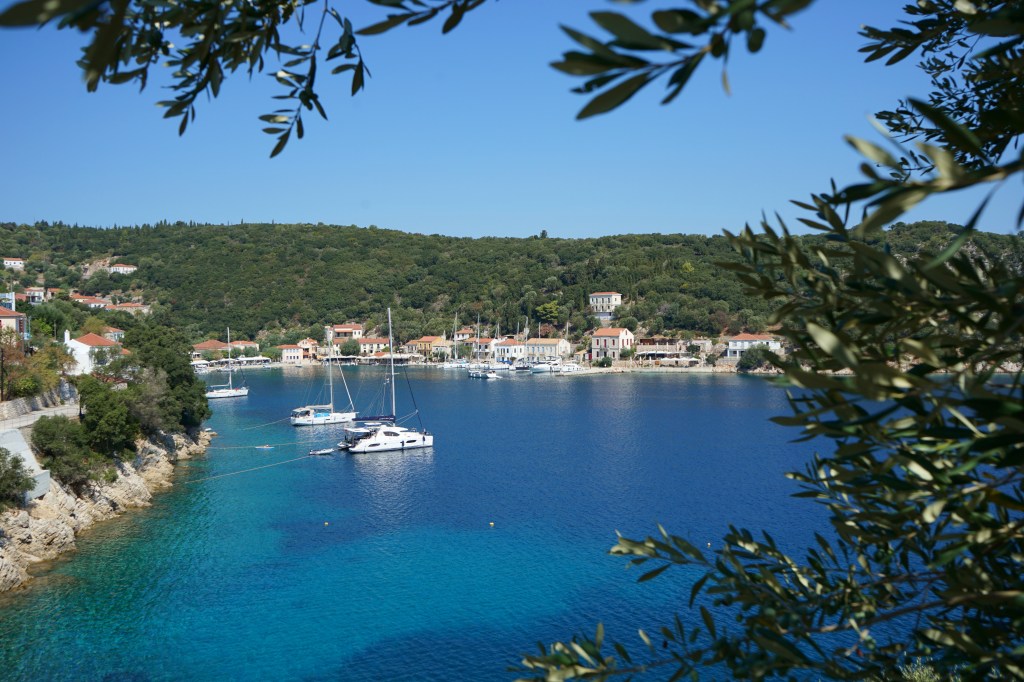
Goats and myth may dominate the Ithacan landscape, but the island also emanates a subtle sense of quiet beauty in its idyllic villages and rocky shores, its neglected ruins and steep hills. Some of it may stem from the myths, the isolation of the island itself, or even simply from being a backwater for so many centuries, millennia even.
And whether the island was home to Odysseus or not, it is, of all the places I’ve visited in Greece, the one that I could see myself call home.
 ADVENTURE-SOMEWHERE.COM
Amazing! I didn’t know Ithaca actually exists. 😃
LikeLike